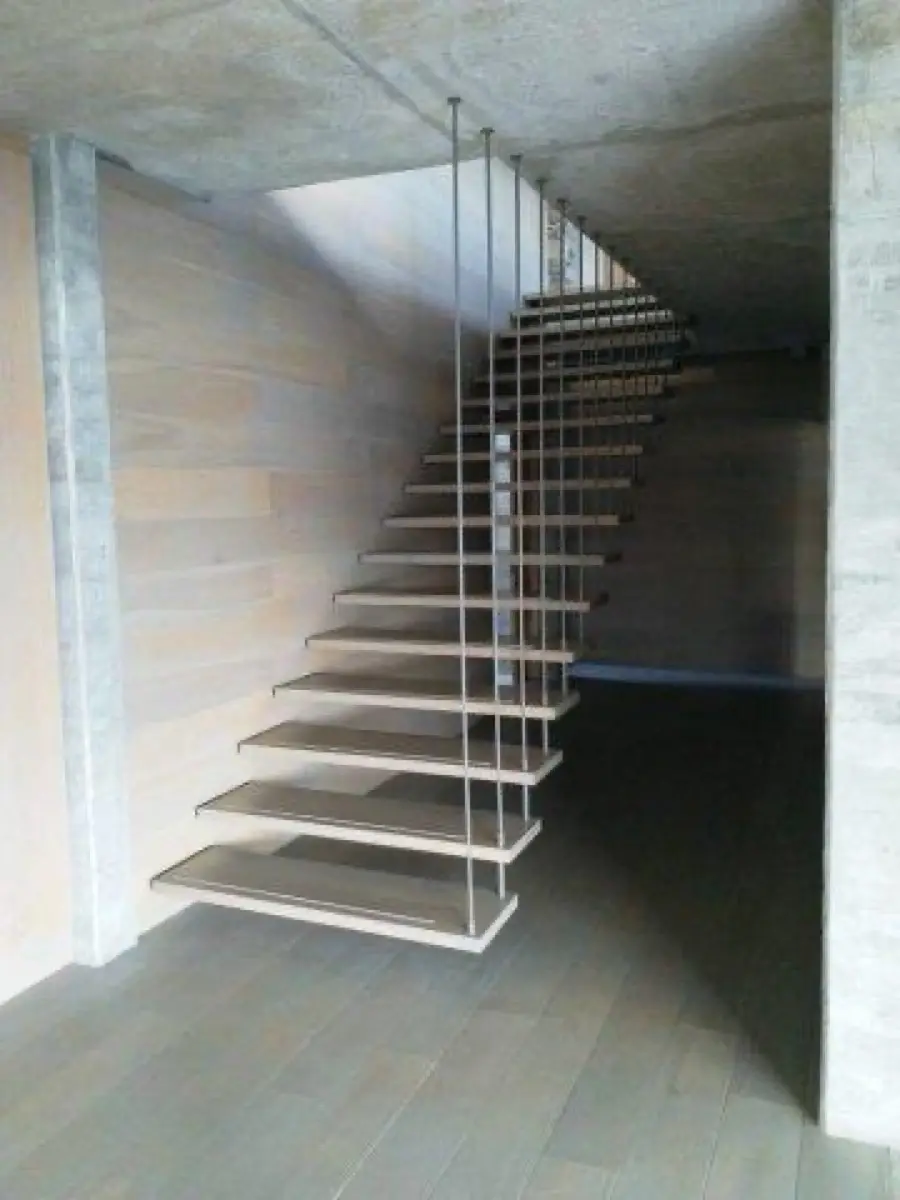
Starting with the opening
The available floor opening determined the staircase geometry before any design decisions were made. Rise, going and total run had to resolve within the structural opening the architect had specified — which is the right way to approach a new build, because it means the staircase is genuinely integrated rather than accommodated.
The clients wanted as little visual mass as possible. That pointed towards a central mono-stringer in mild steel — a single structural spine from which the treads cantilever on both sides. It is a demanding fabrication, because the stringer has to carry significant load in torsion, but it produces the floating quality that makes this type of staircase architecturally effective.
Material decisions
French oak treads were chosen for their colour — a pale, consistent tone that suited the white interior and timber joinery used elsewhere in the house. The treads are substantial in section to avoid any flex underfoot, a detail that matters less visually but significantly affects how the staircase feels to use over time.
The balustrade is frameless glass with a minimal top rail in brushed stainless steel. The glass panels are set in low-profile spigots that are almost invisible from the staircase itself, which keeps the overall silhouette clean. The mild steel stringer was primed and finished in a fine-texture black powder coat — a contrast to the pale oak that the clients had seen in reference images and were certain about from the outset.
What the finished staircase does
A staircase like this is not simply a way to move between floors. In a large entrance hall it becomes the thing you look at when you arrive, and the thing that gives the space its scale. The floating quality — treads that appear to emerge from the wall with no visible support — creates a sense of considered lightness that reads very differently from a conventional stringer staircase.
For Sterianos, commissions of this type represent what three decades of fabrication experience make possible. The geometry, the structural resolution, the finish quality and the installation precision all have to be correct — there is nowhere to hide in a piece this visible.
Have a project in mind?
Start a conversation